
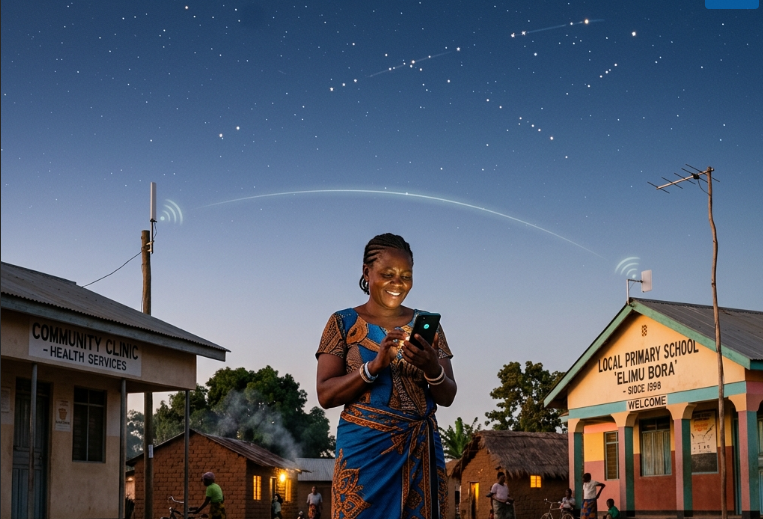
NETLITE™ brings internet to rural communities where conventional telecommunications are weak or unavailable. That connectivity is the foundation AgriTech depends on: without it, drone monitoring, digital farm intelligence, remote advice and market access cannot reach the farm. Community Internet Hubs make that access real for farming communities.
Internet for rural communities — the AgriTech layer
- Brings internet to rural and farming communities
- Connectivity layer that AgriTech services build on
- Local Wi-Fi, registration, bandwidth tiers and priority for essential services
- Delayed synchronisation when connectivity returns
Telemedicine, education and business in farming communities
Through Community Internet Hubs, NETLITE™ enables telemedicine, education and business in farming communities. Remote health practitioners can reach the hub, learners can access educational content, and farmers and local enterprises can trade, bank and coordinate — turning a single managed connection into community-wide opportunity.
- Telemedicine: remote practitioner and health-worker access via the hub
- Education: local learning content and remote classes
- Business: market access, payments and coordination for farms and enterprises
- One managed connection serving the whole community
One managed connection, many users
Shared satellite or alternative backhaul is not unrestricted full-bandwidth internet for everyone at once. The hub organises capacity through registration, access control, quotas and caching so a large community can participate through one managed link — more efficiently than separate individual subscriptions.
- Local Wi-Fi and network access for registered users
- Bandwidth management with usage tiers and quotas
- Local caching of frequently used content
- Priority access for health, education and essential services
- Free and premium packages assumed for pilot modelling — to be validated, not confirmed commercial outcomes
Offline-first where continuous connectivity cannot be assumed
NETLITE™ is built for places where connectivity is intermittent, expensive or unavailable for long periods. Local applications, questionnaires, education and community workflows continue offline. The external connection is used when available for synchronisation, remote support, updates and data transfer.
- Local processing and data storage on the hub
- Delayed synchronisation with central systems when the link returns
- Recovery-oriented workflows for questionnaires and field data
- Cloud sync, telemedicine and payments when backhaul is available
- Reduced dependence on always-on broadband for African and remote-field conditions
Remote practitioner access through the hub
Hubs provide the local environment for remote practitioners, specialists and diaspora professionals to support community care. Telemedicine uses the managed backhaul when available, while local MEDTRAC™ workflows continue so care does not stop when the link is intermittent. The model supports professionals — it does not replace them.
- Remote practitioner and telemedicine access via the hub
- Priority bandwidth for clinical collaboration on shared capacity
- Works alongside screening, questionnaires, triage and health education
- Local health workers continue intake, screening and follow-up on the ground
- Demand management keeps essential health traffic ahead of general use
Hub Version 2 for African field conditions
The next development stage is NETLITE™ Community Internet Hub Version 2 — equipment designed for heat, unreliable power and limited telecoms. AQUAPOWER is the custom battery/solar solution intended to support NETLITE™ and the MEDTRAC™ appliance under those constraints.
- High-temperature and unstable-power operating environments
- Offline and delayed synchronisation as standard
- Local application hosting for health and community services
- Compatibility with offline mobile application development
- Post-funding Africa-ready deployment layer for pilots from 2027
African pilots from 2027
Community and ministry-backed pilots are planned to begin in 2027, building on the Malta proving ground at Atlantis Clinic. African deployment takes MEDTRAC™ into community settings with NETLITE™ connectivity, portable screening and online/offline questionnaires designed for local conditions — subject to funding, partnerships and country readiness.
- Remote-access pilots using available MEDTRAC™ and NETLITE™ capability
- NETLITE™ Community Internet Hub deployment alongside Questionnaire Version 4
- Recruiting clinics, ministries, NGOs, universities and funders for 2027
- Staged expansion across locations as the operating model is refined
- Each stage informs software, hardware, training, costs and national rollout plans
Sustainability model for free community access
NETLITE™ may combine free community access with premium connectivity, advertising and local digital services. Indicative planning assumes commercial activity can help cross-subsidise MEDTRAC™ health services and hub operating costs. Figures used in partner discussions are planning assumptions for pilot modelling — not confirmed revenue results.
- Indicative hub serving ~1,000 registered users with free and premium tiers
- Premium connectivity, local advertising and payment services under consideration
- Commercial activity intended to subsidise free access, health services and hub operations
- Payment services through licensed partners — NETLITE™ provides the access layer
- Coordinated funding needed to move from development into African pilot deployment